
July 30, 2026
It’s close to 05:00 here in New Delhi. I’m at the airport drinking coffee, waiting to board my flight to Istanbul, where I’ll connect to Panama. I would have wanted to delay this trip a few days, to spend time with Natalia and Woland, and to finish some pending deliverables. I only got back to ND last Sunday, after two weeks of intense work in Mozambique. But there were no other flights at reasonable prices for next week.
Usually, I don’t check a bag but today I’m traveling with two large duffel bags. I’m bringing new carpets and a runner for BEHEMOTH, along with things like an EPIRB, full weather gear, boat shoes, a ditch bag, knives, a Jetboil, and freeze-dried food.
I’m supposed to land in Panama at 20:30 Thursday (it’s Thursday morning here in New Delhi). Olmedo will pick me up and take me to Vista Mar marina. He agreed to buy some provisions so we don’t have to stop along the way. I should be at the marina around 22:30, and I’ve been told the night guards will take me out to the boat. I hope everything is in good order and I can just fall into my bunk for a good night’s sleep.
My son Juan David will arrive on Friday, just in time for his birthday on Saturday. I plan to cook a nice dinner to celebrate aboard BEHEMOTH. On Sunday or Monday we’ll sail to Islas Las Perlas, cruise for a few days, then head back to the marina to switch crew: Juan David departs and Natalia arrives to do more of the same.
As for time travel, I just finished reading Black Holes and Time Warps by Nobel Prize–winning physicist Kip Thorne. The book was published in the mid-90s, so it isn’t up to date on the latest discoveries; at the time it was hard to imagine that we would ever have actual pictures of black holes. But the story of how physicists eventually came to agree on their existence is fascinating. Soon after Einstein published the general theory of relativity, Karl Schwarzschild, a mathematician, discovered that one of the solutions to the field equations implied the existence of black holes. Most physicists, including Einstein, dismissed the result as a theoretical anomaly. It took some four decades for black holes to become mainstream, in part due to Thorne’s own work. Thorne was also one of the first physicists to use general relativity to show that time travel was possible via wormholes — a sort of tunnel through hyperspace that connects two points in spacetime that can be millions of light-years apart.
Thorne asks you to imagine that such a wormhole is created in your house, connecting the living room with, say, the driveway where a spaceship is stationed. When you step into the wormhole, half of your body is in the spaceship and half in your living room. Now imagine that your friend, partner, or spouse is in the spaceship while you are in the living room, and that through the wormhole the two of you are holding hands. Let’s say the person is a woman: she fires the engine and travels close to the speed of light away from Earth for a couple of hours — still holding your hand through the wormhole.
By her time, and by the watch on your wrist, two hours have passed. But because time almost stops near the speed of light, for another observer back on Earth — say your dog or cat — some five years have elapsed. Then she turns back: a four-hour trip in total, but on Earth ten years have passed. You are still holding hands through the wormhole, and only four hours have gone by on your watch. Yet when you look out the window, the ship is not there. When it finally arrives, your dog or cat rushes out of the house to greet her, thrilled because they haven’t seen her in years. After jumping all over her, they follow enter the wormhole — and there they find you, holding hands, ten years younger. The wormhole has become a time machine connecting the present to ten years in the past. You cannot travel more than those ten years back, in that particular wormhole.
Although theoretically possible, physicists don’t think it can actually happen in real life. But maybe, as with black holes, in a few years they’ll change their minds…
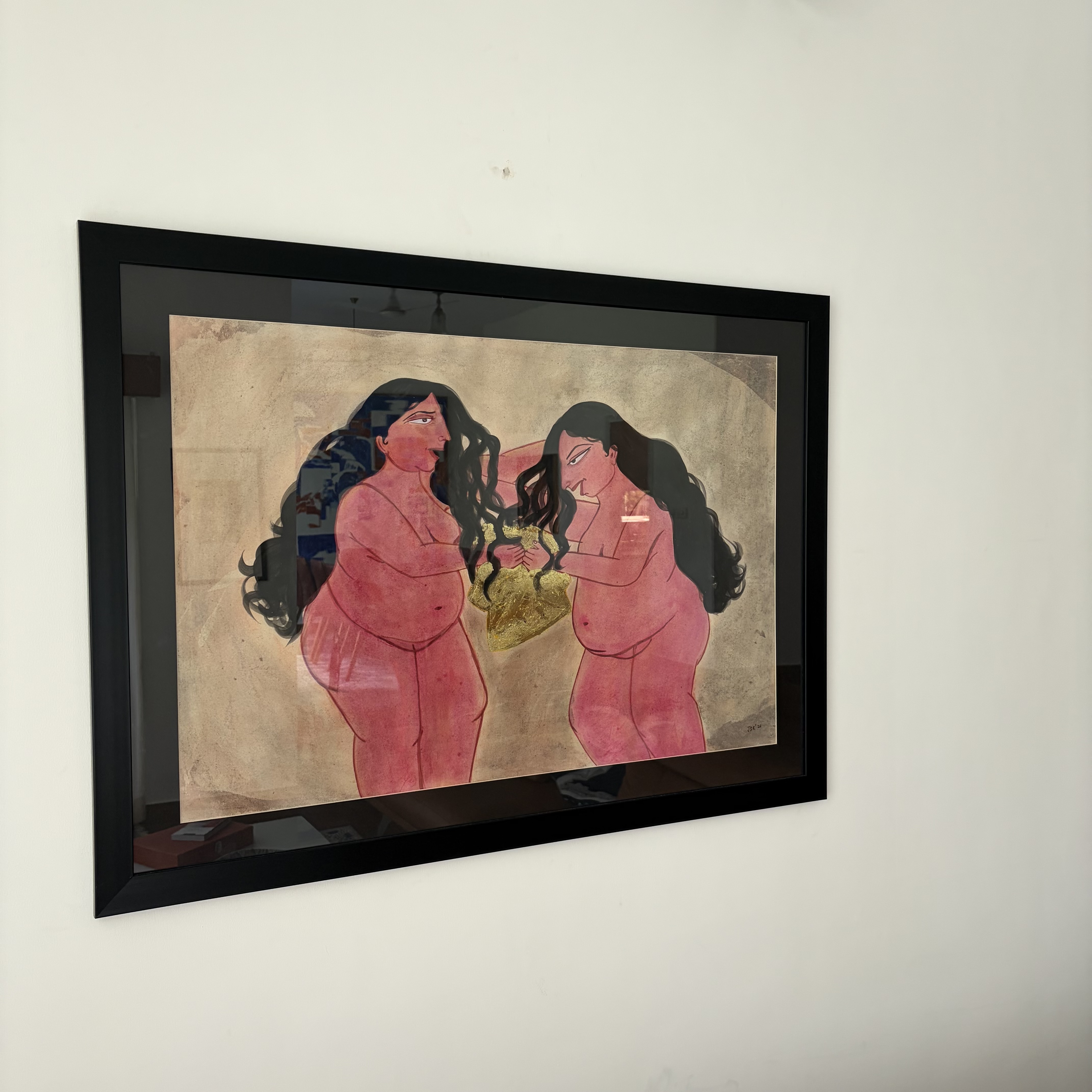
The two pictures in this post are unrelated to what I’ve written so far. The painting is a new acquisition from an Indian artist, Jahnvi Singh Rohet. Before I traveled to Mozambique, Natalia and I wandered into a random art gallery and both liked it. She convinced me to get it.
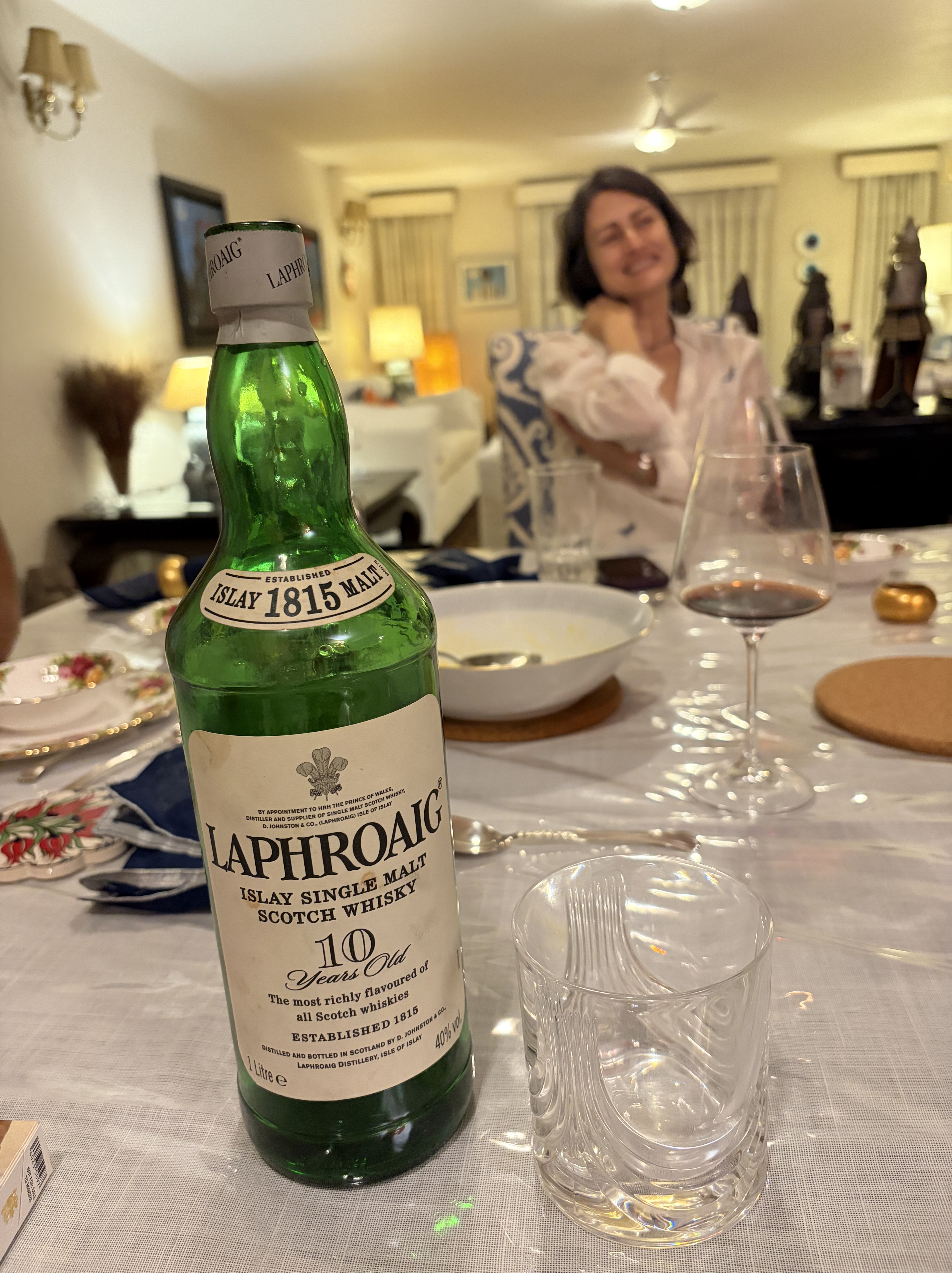
The second picture is of a dinner invitation two nights ago from our landlords, who live in the house next door. They don’t drink, but they were generous with the gin and wine. And to end the meal, I was offered a glass of Laphroaig — the last of a bottle that who knows for how long they have kept. I was pleasantly surprised. Natalia is on the background of that picture and she seems to be enjoying the occasion.
 Sailing to the Pacific